JAPANESE, ONE USEFUL IDEA AT A TIME
A 15-minute Japanese listening session with a clear finish line
Pick a short clip, test one prediction and keep an honest record of what you heard.
Pick a short clip, test one prediction and keep an honest record of what you heard.
Choose less audio than you think you need
A two-hour podcast is a lot of material, but it is not automatically a better study session. For fifteen minutes of focused practice, choose a short section with a clear situation and an authorized transcript or teaching notes. The Japan Foundation's Erin's Challenge and Irodori Starter are possible sources of structured learning material.
Aim for a section you can replay without losing track of where it begins. You should recognize some words and understand the basic setting after a little support. If the entire recording is noise to you, shortening it or moving to easier material is task design, not failure.
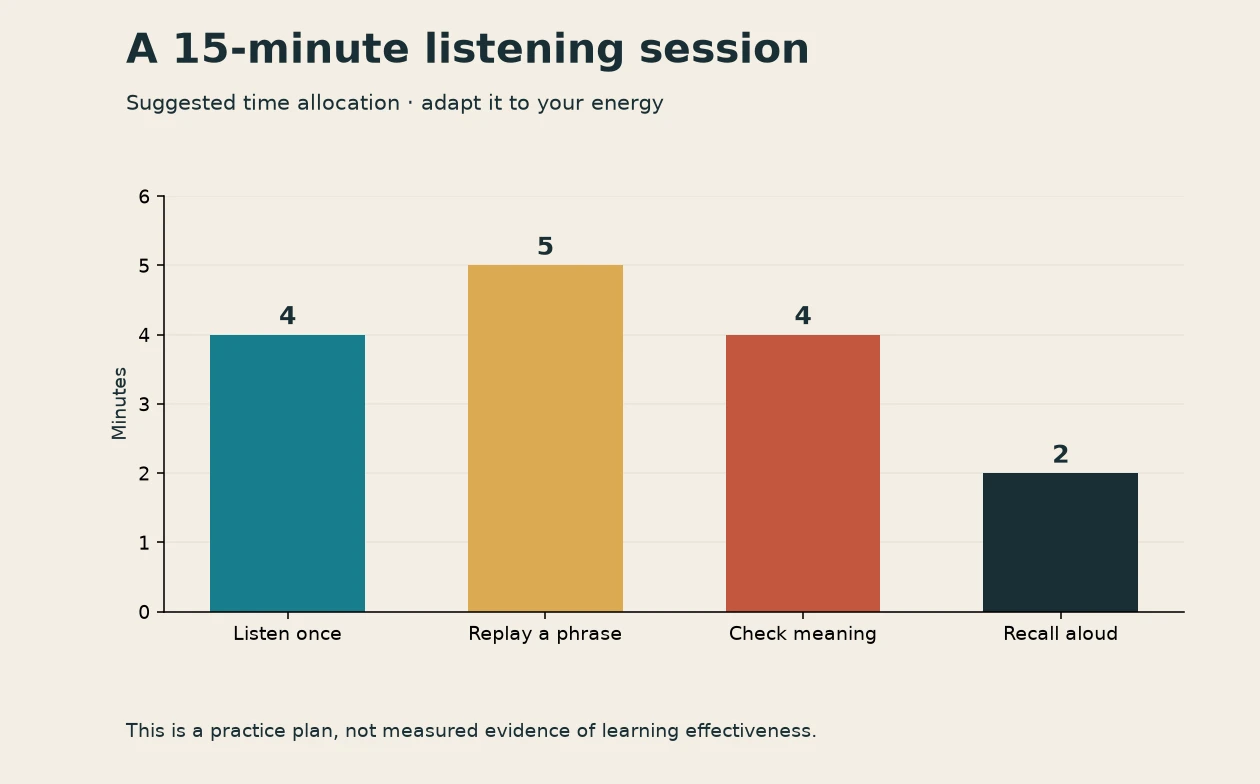
Minutes 0–4: listen and predict
Listen once without reading. Write one concrete prediction: “They are deciding where to meet” or “Someone cannot find an item.” Then listen again for a detail that could confirm or challenge that prediction. It might be a place word, a question ending or a repeated noun.
Keep “heard” and “guessed” separate. If you heard 駅 but only guessed that a train was late, write that honestly. A plausible story is not the same as decoded audio. Your first note can be wrong; its job is to give the next listen a question.
Minutes 4–9: check one obstacle
Open the transcript and find one place where your expectation differed from the words. Decide what caused the mismatch. Was the word unknown? Did you know it on paper but miss it in speech? Did you recognize the words but misunderstand the grammar? These problems need different practice.
For an unknown word, check meaning and reading. For a sound mismatch, replay the short phrase while following the text. For grammar, write a simpler example with the same relationship. Avoid “I am bad at listening” as the diagnosis; it does not tell you what to do next.
Minutes 9–13: listen without the page
Close the transcript and replay the same section. Can you now locate the phrase you checked? Then answer one meaning question without repeating the transcript word for word. For example, if the scene concerns a meeting, say where the people will meet and what evidence you heard.
You may recognize the passage partly because it is familiar. That is useful practice, but it does not prove you can understand any new speaker or topic. If you want a transfer check, try another short example with the same vocabulary on a later day. Keep the two results separate.
Minutes 13–15: leave one useful note
Write the source, the timestamp, the obstacle and the next action. Example: “I knew the verb in writing but missed the past ending; next time compare present and past.” Use your own words. You do not need to store the full transcript.
Keep one original sentence in Japanese Adaptive Recall if it is useful for your goals. Then stop. The fifteen-minute schedule is a practical suggestion, not a universal optimum. What matters is that the session ends with a clearer understanding of one problem and an achievable next step.
十五分で終わりが見える日本語リスニング
音声は思ったより短く選ぶ
二時間のポッドキャストは材料が多いですが、それだけで良い学習になるわけではありません。十五分の集中練習には、場面が明確で、正規のスクリプトや学習メモがある短い部分を選びます。国際交流基金のエリンが挑戦!にほんごできます。やいろどり入門が教材の候補になります。
始まりを見失わずに繰り返せる長さにします。少し補助があれば場面が分かり、いくつかの語を認識できるものがよいでしょう。全部が分からないなら、短くするか易しくします。失敗ではなく課題の調整です。
最初の四分:聞いて予想する
一回目は文字を見ずに聞き、「待ち合わせ場所を決めている」「物を探している」など、具体的に予想します。二回目はその予想を確かめる情報を一つ探します。場所の語、質問の終わり、繰り返される名詞などです。
聞いたことと推測を分けます。「駅」は聞こえたが、電車が遅れているのは予想なら、そのまま記録します。もっともらしい話と、聞き取った内容は別です。最初の予想は間違っていてもよく、次に聞く目的を作るためのものです。
次の五分:一つのつまずきを確認する
スクリプトを開き、予想と実際の言葉が違った箇所を一つ探します。未知の単語だったのか、文字では知っていたが音で分からなかったのか、語は分かっても文法を取り違えたのか、原因を分けます。
未知語なら意味と読みを確認します。音の問題なら、文字を追いながら短い表現を聞き直します。文法なら同じ関係の易しい例を作ります。「聞くのが苦手」だけでは、次にすることが決まりません。
次の四分:文字なしで聞く
スクリプトを閉じ、同じ部分を聞きます。確認した表現の位置が分かるでしょうか。次に、全文を暗唱せず内容の質問に答えます。待ち合わせの場面なら、どこで会うのか、どの音声を根拠にしたのか説明します。
慣れたから分かる部分もあります。それも練習になりますが、未知の話者や話題をすべて理解できる証拠ではありません。別の例への応用を確かめるなら、後日、同じ語彙の短い別音声を使い、結果を分けて記録します。
最後の二分:役立つメモを残す
出典、時刻、つまずき、次の行動を書きます。たとえば「動詞は文字で知っていたが、過去の語尾を聞き逃した。次は現在と過去を比べる」です。全文を保存せず、自分の言葉で残します。
目的に合う自作文があれば、Japanese Adaptive Recallで練習し、そこで終えます。十五分は実用的な提案で、全員に最適な時間という意味ではありません。一つの問題が明確になり、次の一歩が決まればよいのです。
Put this idea into practice
Keep reading
Better Japanese Anki cards: keep the context, shrink the question
Turn an overloaded Japanese flashcard into a clear recall task, with original examples and a practical rule for editing frustrating cards.
DiccionarioJaponés.com: a useful Japanese–Spanish companion from Matías Acosta
A shoutout to Matías Acosta, plus a practical way to turn a Spanish dictionary lookup into Japanese you can actually use.
VoiceType AI for issue drafts: speak the idea, then check every identifier
Dictation may help with technical prose, but names, commands and language switching need an explicit correction pass.